Beyond the Classroom: How Passion Projects Shape Your Future
How Students at We-Learn Are Combining Subjects, Hobbies, and Creativity to Build Projects That Stand Out
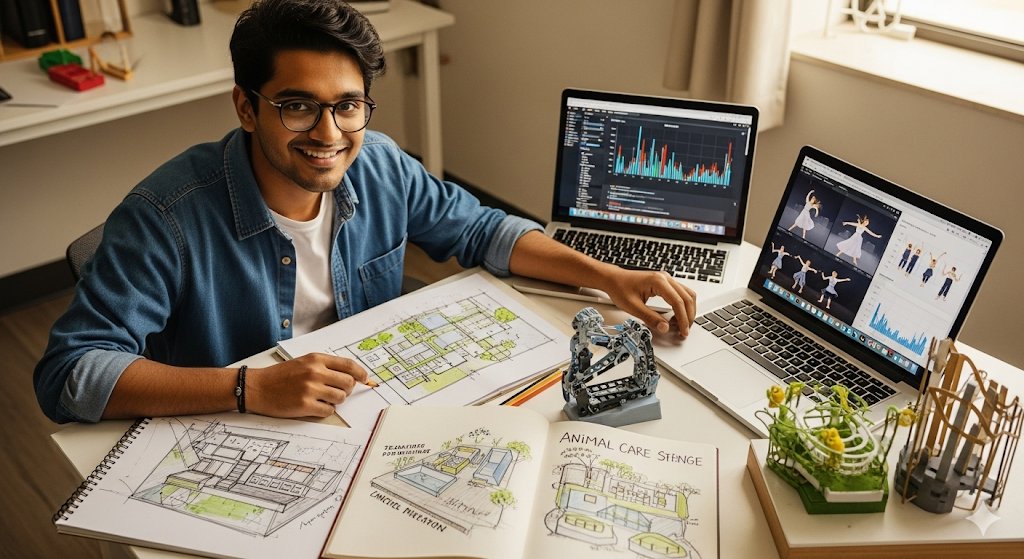
At We-Learn, we've always believed that creativity isn't limited to those who call themselves artists. It shows up in quiet ways, in the shape of a booklet, a mind map, a research question, or a simple personal story.
We've seen more and more students bring their academic goals and personal interests into the studio. Some of them are applying for creative courses like architecture or design. Others are headed towards more conventional career paths. But all of them come here looking to make something that feels more like them, something thoughtful, personal, and real.
What starts as a casual conversation often turns into a project that helps students reflect on what they care about, and how they want to show up in the world.
And sometimes, that project becomes the very thing that sets them apart on a university application.
From Passion To Purpose
One of our students, Nushi, dreams of becoming a veterinarian. She has always loved dogs and wanted to do something meaningful around animal care. During her time at We-Learn, she began exploring ways to combine her passion with real-world impact. That's when she came up with Creature Comforts—a space designed for animal grooming, a clinic, and a rehabilitation centre.
Her idea was simple but powerful: to create a place where animals could be cared for holistically, not just treated when sick. She sketched out service models, researched animal well-being, and even designed the branding herself. "It felt like I was finally building something that brought together my love for animals and my dream of becoming a vet," she said.
When Dance Meets Data
Sonechka is a math student who also happens to love dance, particularly hip-hop. At first, the connection between the two wasn't obvious. But after a few mind-mapping sessions, she began noticing something interesting: geometry was everywhere in movement.
She started analyzing angles, symmetry, and spatial rhythm within choreography. Her final project explored how geometry shows up in the human body during dance and how movement can be mapped, calculated, and designed.
The result was a visual study that was part sketchbook, part research, and completely unique to her. "I started out just wanting to do something with dance," she said. "But now I see math differently too."
From Curiosity To Discovery
When Shreyas, an aspiring biochemist, began his project journey at We-Learn, he mentioned his fascination with how medicines have changed over time. Not just the science of it, but also the way drugs evolved from natural remedies to complex modern formulations. That curiosity was enough for us to start asking questions.
Together, we traced the story of medicine: the origins of ancient healing practices, the breakthroughs of early drug discoveries, and the biochemistry that continues to shape treatments today. What emerged was a passion project that mapped the evolution of drugs and medicine—blending history, science, and future possibilities.
"It helped me see biochemistry not just as formulas in a textbook, but as a living story of how humans have always tried to heal," he said.
When a Personal Challenge Becomes a Shared Resource
Safwaa came to us with a clear academic direction and that was to pursue psychology. But her starting point wasn't a textbook or a research paper. It was her own experience with anxiety.
With guidance, she created an illustrated guidebook on anxiety, covering signs, causes, and ways to cope. She kept it simple and accessible, and distributed it to her school library and a few local clinics. It was her way of turning something personal into something helpful.
"I used to think my anxiety was something I had to hide," she said. "But this made me feel like I could do something good with it."
Projects That Come From Anywhere
At We-Learn, not every project starts with a subject. Sometimes it starts with a hobby, a question, or just something you enjoy doing in your free time.
We've had students, design crockery collections because they love plating food, build language guides inspired by family travel, combine medicine and comics to explain complex topics to kids.
There's no "right" topic. And there's no one way a project should look. What matters is that it means something to the person making it.
How We-Learn Supports the Process
Our role isn't to prescribe ideas, it's to help students find them. We begin by asking questions: What are you curious about? What do you want to study? What would you create if there were no rules?
From there, we help students, map connections between interests and themes, explore formats (books, illustrations, prototypes, models, etc.), guide them through drafting, design, and iteration, document their work in ways that reflect clarity and intention.
We've seen that when students work on something that comes from within – rather than just following a prompt, their projects naturally become more meaningful, more thoughtful, and more memorable.
And that often becomes the part of their application that people remember.
Making Space for the Whole Self
Not every student we work with wants to be an artist. But every student has something worth expressing, an idea, a question, a connection that no one else sees in quite the same way.
By creating space for students to explore those ideas, we're not just helping them make better projects. We're helping them see that their interests, their hobbies, and even their academic paths don't need to be separate from their creative work.
They can be part of the same story. And that story is worth telling.