Creative Arts and Humanities BA at UCL
Preparing Students for the Future of Creative Industries
Embracing Creativity and Critical Thinking
In this reflective essay, Gregory Thompson, Professor of Creative and Collaborative Enterprise at UCL, draws on ancient Indian tradition to think about the relationship between machines, human beings and the skills our students will need for the future. Gregory argues that—in a world of machine learning and automatization—the skills that will be valued above all are creative and critical skills: the ability to understand an ever more complex world and to do the things that robots cannot do.
This is the approach that underpins UCL's innovative BA in the Creative Arts and Humanities. This programme gives students high-level critical and analytical skills, alongside creative skills in performance, writing and moving image. It prepares students for roles in the Creative and Cultural Industries, but also for a wide range of roles (in business, in start-ups and entrepreneurship, for jobs that don't even exist yet) where there is a need to understand complexity, to tell persuasive stories, and to work creatively with others.
Historical Perspectives
They say that everything is contained within the Mahabharata, and in India machines have been doing the heavy lifting since the days of the Rgveda and Atharvaveda where there are two names for the plough: laangala and seera. These ploughs of wood and bronze and iron increased productivity. The Yajurveda tells of a twelve-oxen plough cutting deep into the earth and turning the soil so that it will yield more. The bull was put on the yoke so that the human was free to invent textiles, mathematics, and steel.
Evolution of Work and Education
The world of work has been evolving for thousands of years. In every generation the machines eat some jobs and produce new ones. The car, the train, and the steam engine replaced some jobs and created new ones. AI is no different to the electric light, the telephone, the computer, or the internet. Parents want their children to learn to do something that will not be obsolete. Education has been traditionally about special information absorbed through study, and the university has been the way of gaining access to that knowledge. But now, all that knowledge has now been uploaded to Large Language Models that will answer any prompt.
Future Challenges
AI and the Large Language Models are coming for the creative industries. Many of the copywriters and the graphic designers, the wordsmiths and the image makers, can be replicated by the responses to prompts typed into chatbots. There will be a proliferation of ideas, articulations, and memes, generated by tapping keys and clicking screens.
Human vs. Machine
So, what is it that the human can do that the machine cannot? Machines do what they're told. And humans in merely functional roles do what they're told. The more that machines do the expected, the more we need humans to do the unexpected. Machines generate a form of novelty by combining existing ideas. But humans can create ideas that have never been thought before. Humans can understand and explain. Humans can solve problems. Humans can evaluate which of the multitudes of ideas made by machines are useful. It's humans who generate valuable knowledge through creativity, criticism, and evaluation.
Innovating Beyond Boundaries
The workplace of the future needs critical creative humans that understand innovation: humans that can explain problems to other humans (and to machines); and humans that can organise other humans to work together to create more than they might otherwise create by themselves. This goes beyond the old certainties of command and control, and requires courageous and inventive collaboration.
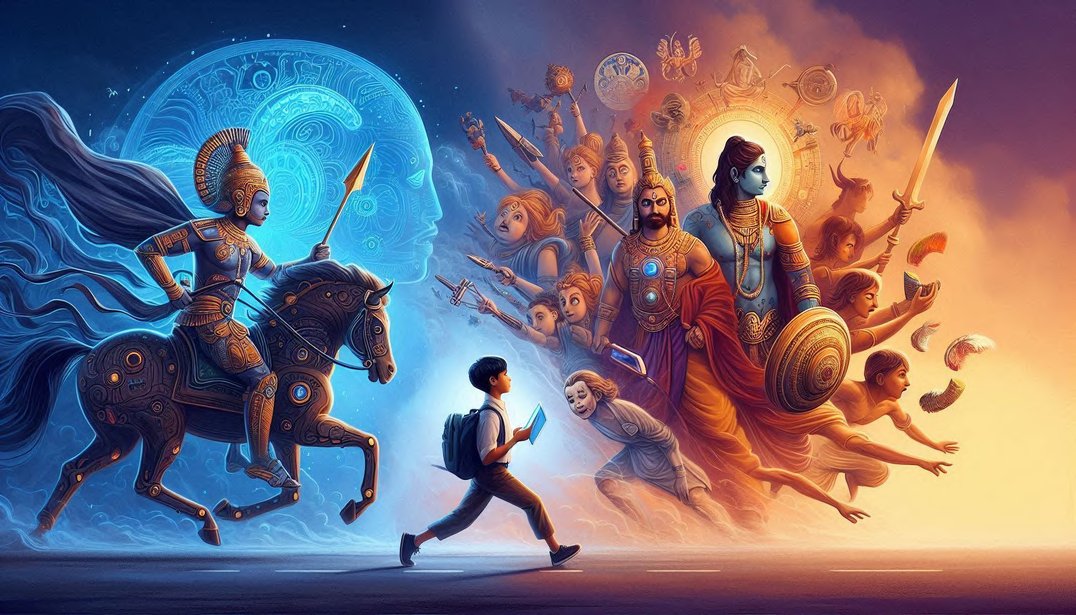
The university must prepare students for a brave new world that is already here. We have machines crammed full of past ideas, words, images, and memes—machines ready to reproduce what has been before. In the Mahabharata, Krishna urges Arjuna to break free of the past, transcend karma, and go beyond the mechanical. We need students who also go beyond the mechanical—students who both absorb information through study and learn to solve problems in new ways. We need students who innovate and create things that are unlike what has been produced before—students who can evaluate critically and build relationships."
Website: https://www.ucl.ac.uk/prospective-students/undergraduate/degrees/creative-arts-and-