How Students at We-Learn Are Combining Subjects, Hobbies, and Creativity to Build Projects That Stand Out
Beyond the Classroom: How Passion Projects Shape Your Future
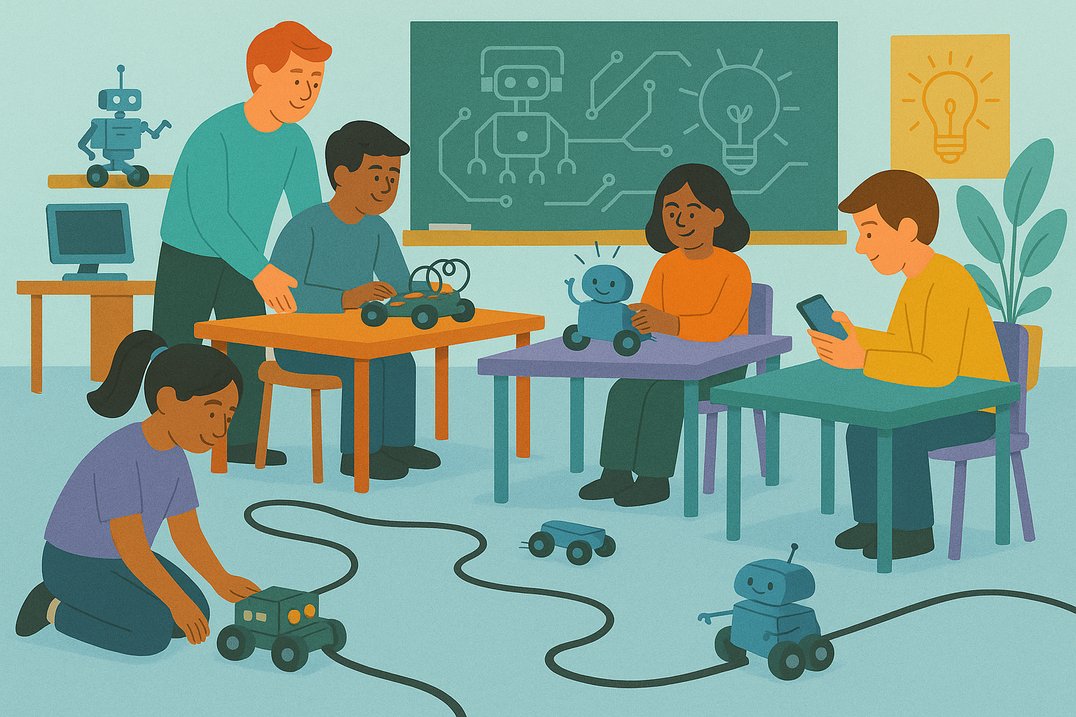
At We-Learn, robots aren't just machines – they're imagination in motion. Every whirring motor and tiny wheel is a playground for ideas, a chance to experiment, and a reminder that creativity can be built, tested, and even a little messy.
Robotics here isn't about coding perfection or following instructions to the letter. It's about curiosity: What if this could move on its own? Could it respond? Could it surprise me? And then rolling up your sleeves to make it happen. The process is playful, hands-on, and full of those magical moments when an idea sparks into reality, sometimes in ways even the students didn't expect.a
From Wobbly Wheels to Wow Moments
Vansh walked into the studio with wide eyes and zero experience, staring at a tangle of wires that looked more like spaghetti than science. His first challenge was a line-follower robot, designed to trace a track on its own. At first, it zigzagged wildly, spinning off course like a tiny robot with a mind of its own. But every "oops” moment became a clue. With a few adjustments, the bot glided smoothly along the track. Watching it move, Vansh laughed, “It's like I taught it to think!” That first success wasn't just about a robot moving – it was about discovering that experimenting, failing, and trying again is part of the fun.
Ishani wanted more than a line follower. She dreamed of a robot that would respond to her phone. Her first attempts ended in chaos: the car spun, bumped, and refused to obey. But with persistence and creativity, she figured out the design, and the first time her car obeyed her command to move forward, she couldn't stop grinning. “It's like magic, but I made it!” she said. And in that moment, she realized that robotics isn't just about building machines, it's about building confidence and problem-solving skills
One of our students Risha, designed and built a Sun Finder robot that moves around until it locates sunlight. She carefully programmed and adjusted its sensors so it could detect light and navigate efficiently. Watching her robot roam the studio, searching for the brightest spot, Risha learned how experimentation and fine-tuning can bring an idea to life. For her, the project was not just about building a machine; it was about the joy of seeing her creation work on its own.
Creativity in Motion
At We-Learn, robotics and AI are about more than just putting parts together. Students imagine, sketch, test, and rethink until their creations come alive. Every misaligned wheel, every blinking sensor, and every unexpected spin becomes a chance to experiment. Sometimes mistakes lead to the coolest ideas. The moments when a robot behaves in a way no one predicted often spark the most laughter, collaboration, and innovation.
As students grow bolder, they start asking bigger questions. What if the robot could sense obstacles and change course? What if it could react to its environment? That's where AI enters the conversation, not as lines of code, but as creative problem-solving in motion. Meha, for instance, experimented with sensors to make her robot slow down when it “bumped” into an object. Watching it respond, she exclaimed, “It's like it knows!" AI here isn't abstract or intimidating, it's imagination given a way to act in the real world.
Insights from the Experts
As students explore robotics and AI, it helps to see how their work connects to the wider world. A recent seminar with Dr. Vincent Wilczynski, a Yale professor, highlighted how hands-on experience shapes learning. "Students are encouraged to learn by doing, building projects, exploring courses, and adapting to the latest technology,” the professor explained. “Even in robotics and AI, portfolios are essential. Students present their projects and the work they've done with robots,
and these portfolios act as an introduction – whether to a university or a future workplace. It's a way to showcase creativity, problem-solving, and technical understanding all at once."
For students at We-Learn, this approach has immediate benefits. Every line-follower bot, phone-controlled car, or sensor-driven prototype becomes a piece of their portfolio. These projects are tangible evidence of initiative, experimentation, and creativity, and they help students stand out in competitive university applications or early career opportunities.
Building More Than Robots
In the end, robotics and AI at We-Learn aren't just about machines. They're about the mindset of invention. Students leave not only with robots they can hold, drive, and show off, but with the ability to approach challenges differently, adapt when things go wrong, and push their ideas further than they thought possible. Every bot, every quirky misstep, every “aha” moment in the studio is proof that curiosity, creativity, and hands-on exploration can turn ideas into reality.
At We-Learn, building the future isn't about waiting for technology. It's about picking up the tools at hand, thinking boldly, and creating it yourself — with a smile, a laugh, and maybe a little controlled chaos along the way.