NYU Abu Dhabi: Here's What Makes It Small, Selective, Structured
Inside a Controlled, Global Campus Built for Depth, Immersion, and Long-Term Outcomes

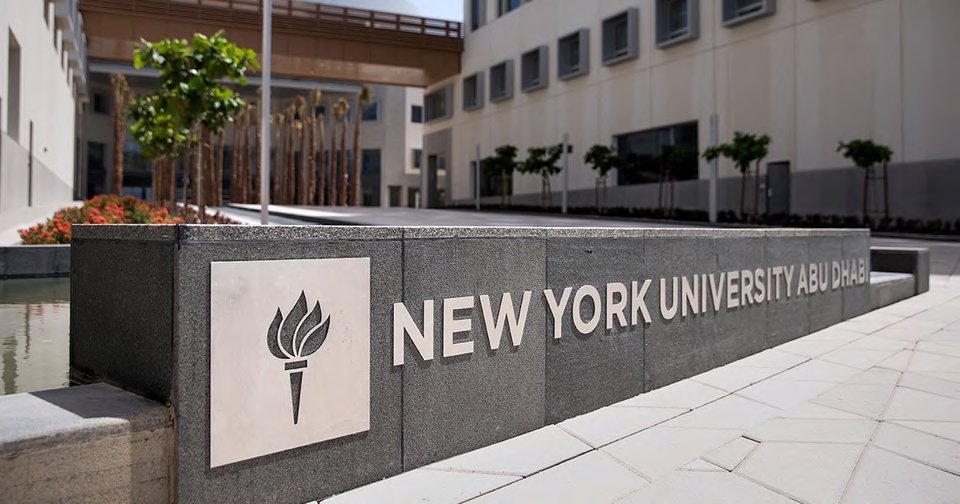
New York University Abu Dhabi operates as a standalone undergraduate campus of New York University, not a feeder, not a pathway, and with no transfers into or out of NYU Abu Dhabi permitted under any circumstance. The institution is deliberately small, with an incoming class of ~550 students and representation from over 120 countries, creating a tightly controlled academic and social ecosystem. Every student completes a fixed 4-year programme, with no early graduation in 3 years or extension to 5 years allowed. The model prioritises depth, continuity, and immersion over flexibility, making it one of the most structurally rigid yet globally integrated undergraduate experiences available.
Campus Overview
NYU Abu Dhabi is located on Saadiyat Island, within Abu Dhabi's emerging cultural and ecological district, positioned near global institutions such as the Louvre Abu Dhabi and the upcoming Guggenheim. The campus follows a pedestrian-first design, centred around the Central Plaza flanked by 36 palm trees, with all academic, residential, and recreational spaces within walking distance.
The Campus Centre functions as the operational core, featuring a 300-seat lecture hall, 180-seat auditorium, informal study spaces, and direct connectivity to athletic facilities. Above it sits the university library, with a bilingual (Arabic-English) collection and digital workspace. Despite a desert climate with temperatures peaking near 40°C, the campus is fully air-conditioned, allowing continuous academic functioning. The environment is intentionally self-contained, with minimal reliance on the external city.
Academics
Academically, NYU Abu Dhabi follows a traditional liberal arts and sciences model, offering 24 undergraduate majors with all degrees awarded as Bachelor of Arts or Bachelor of Science. A defining constraint is that no academic credit is awarded for IB, AP, A Levels, or any pre-university coursework, regardless of performance. The curriculum is anchored by the Four Competency Requirement, which includes Quantitative Reasoning (Q), Experimental Inquiry (E), and Islamic Studies (X), ensuring exposure to data analysis, scientific thinking, and regional context.
Popular majors include Engineering, Economics, Culture, Context, and Psychology, and Social Research and Public Policy. Engineering focuses on nano-scale to mega-scale problem solving tied to sustainability and climate, while Economics integrates behavioral economics, quantitative modeling, and policy analysis. Research is not deferred. Undergraduate research is funded and mentored from the first year, supported by infrastructure such as a library with 40,000+ books, 1M+ e-books, and 1,200 databases.
Culture
Student life is built on a fully residential model with housing guaranteed for all four years, creating a highly controlled and immersive environment. Cultural diversity is not incidental but structured, with students from 120+ countries living and studying together.
The defining mechanism is the Weyak Group system, where each student is placed in a small group of ~10 students from different national, cultural, and linguistic backgrounds, meeting weekly to ensure sustained interaction. This prevents cultural clustering and enforces integration.
Campus life extends through Student Interest Groups (SIGs), competitive participation in the Abu Dhabi Inter-University Sports League (ADISL), and mandatory physical education courses. Facilities such as the Bahara Zone and performance spaces at the Arts Center support recreation and creative output. The structure ensures that community-building is continuous, not optional.
Admissions
Admissions operate through a single Fall intake, with no Spring entry. The class size is ~550, with 25% Emirati and 75% international students, including 20-40 Indian students annually. The process includes the highly selective Candidate Weekend, where only ~10% of applicants are shortlisted and flown to Abu Dhabi. This stage involves interviews, writing comprehension exercises, and structured academic interactions, and admission is not final without it. Non-attendance is treated as a lack of commitment.
Evaluation is longitudinal, focusing on Grades 10-12 (or 9-12 for IB), with predicted IB scores not considered. Financially, NYU Abu Dhabi offers need-based financial aid only, committing to 100% of demonstrated need, with aid sometimes reaching up to 120%. Annual tuition is approximately USD 86,000.
Career
Career outcomes are highly structured, with 95%+ of graduates securing employment or graduate school placements within 6 months. The Career Development Center (CDC) provides early and continuous support through advising, mentorship, and skill-building. Students complete internships across 40+ countries, with placements at organisations such as Google, McKinsey, the United Nations, Goldman Sachs, and Louvre Abu Dhabi. Many of these internships are fully funded by the university, removing financial barriers to global exposure. Graduates move into roles across finance, technology, government, and research, or pursue further study at institutions like Harvard, Princeton, Yale, Oxford, and Cambridge.