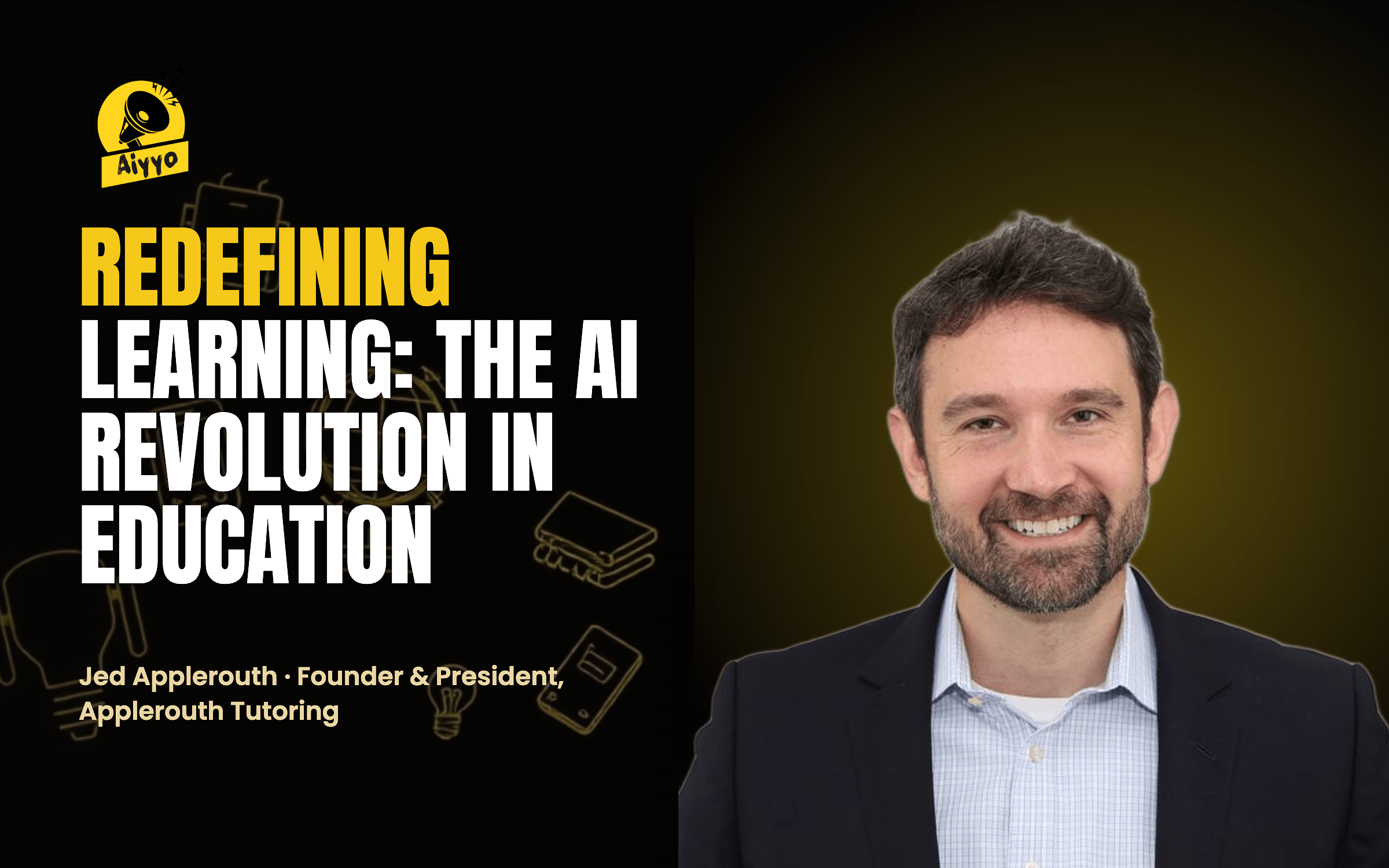
Redefining Learning: The AI Revolution in Education
What Does AI Mean for the Future of Education?

The arrival of Open AI's GPT-4 captured the imagination—and fears—of millions, making it clear that the world would never be the same. While GPT-4 and other AI models like it are not without flaws, they are powerful enough in their nascent form to begin transforming many fields, including education, where they've already had a profound impact.
Artificial Intelligence is all around us: our smart thermostats, turn-by-turn driving directions, spelling and grammar checks, TV and music recommendations. But GPT-4 showed us a world where humans could have a thought partner and teacher in myriad domains, an intelligence that could rock the LSAT, the Bar Exam, the GRE, and a variety of AP exams—so we should all be paying attention.
A Direct Impact in Education
Students are using GPT-4 and other platforms like it to expand their knowledge, complete assignments, generate ideas, and proof papers. In a recent webinar on AI in education, Ben Breen of UC Santa Cruz spoke of his peers in the Spanish department noticing that suddenly all the Spanish essays were being turned in without errors: no comma errors, no grammar errors. Lilach Mollick of UPenn's Wharton Interactive noted that any homework assignment—for a student who is good at prompting (skillfully entering data into GPT-4 to optimize and tailor the output)—could be done using AI.
If an AI can complete any assignment, educators are going to have to begin to rethink both their pedagogy and how they assess student knowledge. Breen noted that given the advent of GPT-4, essay assignments are no longer a real signal for what a student is able to do, and he also identified a range of faculty responses to the new developments in generative AI: some of his colleagues were excited, others were worried, while others were completely oblivious.
Some academics are primarily concerned about the impact of AI on cheating, but Breen argues this is a limited perspective: while cheating is happening, that's not the story here. “When we write about this in 100 years, we won't be talking about cheating.”
In any case, students are embracing AI at a quick clip. One survey found that 30% of college students used ChatGPT for school work in the 2022-2023 academic year. The adoption is only going to increase across the student population.
Potential Applications for College Admissions Offices
At the same time, college administrators and admissions offices are seeing the potential of AI to customize and personalize outreach messaging and marketing, to read and score transcripts and applications, and to synthesize and organize and prioritize mountains of data.
Slate, a leader in CRM for college admissions with 1700 member schools, announced at its 2023 Slate Summit new AI-powered features including the ability to summarize student essays and recommendation letters, calculate GPAs, and expedite transcript review.
It's not so hard to imagine a world where one AI identifies the students to recruit, another AI writes the application for the student, and another AI reads and scores the application. This is a story about humans gaining efficiencies, but losing some of that human contact. Is that a price we are willing to pay?
Either way, colleges are already jumping in to use this technology. One recent survey found that 80% of colleges will be using AI in admissions by 2024.
What Will These Learning Machines Teach Us?
AIs will give us mountains of data at our fingertips, and will force us to become good curators and editors, but every technological advancement comes with some cost. Has spell-check made us better at spelling? Google Maps made us better at orienting ourselves? In most cases, no. We sacrifice some capacity to gain efficiency.
On the other hand, technologists understand that AI is transformational. Just like the personal computer or the internet, this technology will become embedded in our daily lives.
Like many companies, Applerouth is actively examining all the ways this new technology can assist us, our students, and their families. The power to analyze, synthesize, and personalize information and data is very real. There are so many use cases for generative AI, and we hope to harness this new technology to improve the experience of our students and enhance their academic outcomes.