The Vanishing Value of a College Degree
How Structural Shifts, AI Disruption, and Risk-Averse Hiring Are Eroding Entry-Level Opportunities in a Booming Economy
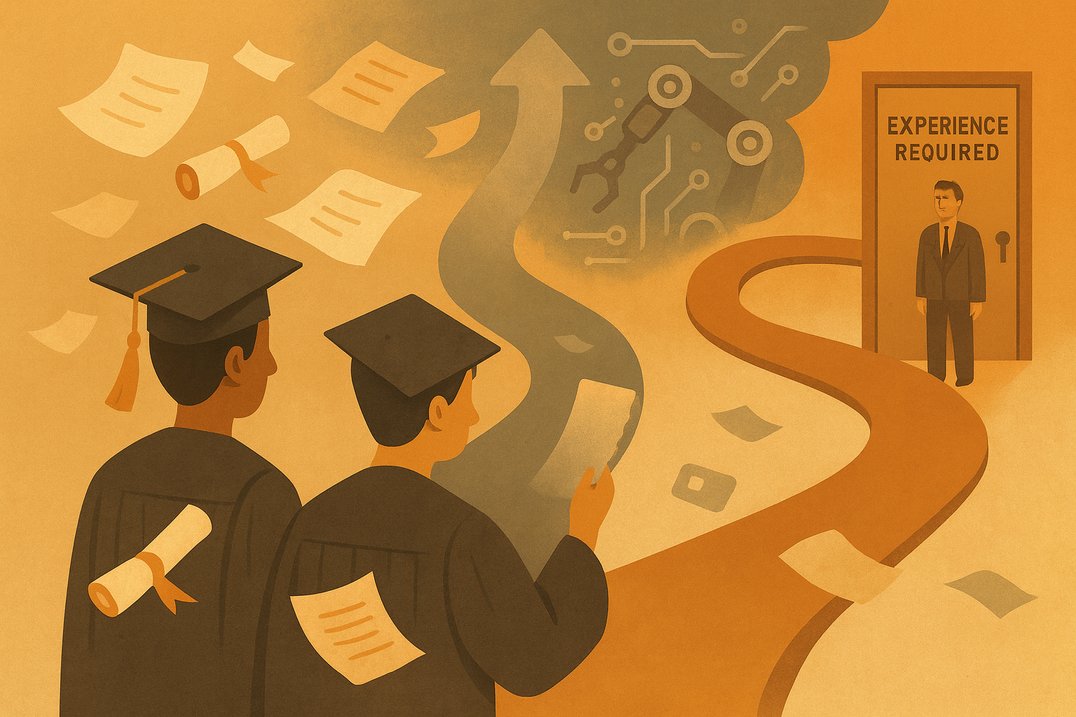
For decades, a bachelor's degree served as a reliable passport to professional employment. But for today's young graduates, that promise is faltering. Despite record corporate earnings and a resilient labor market, those just entering the workforce with college degrees are facing higher unemployment, shrinking opportunities, and an unsettling mismatch between their qualifications and the jobs they can secure.
Recent data from the Burning Glass Institute reveals a paradox at the heart of the American economy: even as industries like finance, tech, and professional services thrive, young college graduates are seeing a sharp uptick in unemployment and underemployment. In fact, more than half of the Class of 2023 found themselves in roles that didn't require a degree at all, a stark reversal of long-standing norms.
1. The AI-Powered Expertise Upheaval
Generative AI is dismantling the very foundation of early-career roles. Entry-level tasks, drafting documents, summarizing reports, handling simple data analysis, are precisely the kinds of activities at which AI now excels. The result? A "Flipped Pyramid” where companies need fewer junior staff to handle the groundwork and instead seek mid-career professionals who can steer strategy, manage projects, and make judgment calls that AI can't replicate. In roles such as marketing, finance, and project management, traditional graduate gateways, which demand talent with less than three years' experience, are plummeting. In their place, postings increasingly call for candidates with six or more years under their belt.
2. Post-Pandemic Lean Hiring Models
COVID-19 taught companies to do more with less. During the upheaval of 2021–2022, many firms streamlined operations, investing in automation and process efficiencies. As a result, when demand returned, they discovered they didn't need to scale up headcount at the same rate as revenue. Today, businesses are reluctant to invest in training junior hires who may take months to become productive. Instead, they're prioritizing experienced workers who can contribute immediately. This risk aversion is proving especially costly for new grads, who now find themselves excluded from hiring pipelines that once welcomed them in droves.
3. The Graduate Glut
More Americans are earning bachelor's degrees than ever before. While this trend reflects positive educational aspirations, it has also flooded the market. By 2034, the U.S. is projected to have 7–11 million more college-educated adults of working age than it did a decade ago. But the growth of suitable professional roles hasn't kept pace. This oversupply intensifies competition for limited jobs, fuels credential inflation, and depresses wages. Even engineering, a field considered immune to such trends, sees over 25% of graduates underemployed today.
4. AI as a Force Multiplier
Rather than being a standalone disruptor, AI amplifies all the above forces. It enables leaner hiring models, makes companies more selective, and exacerbates the experience gap. By automating junior-level work, AI removes the very training grounds that allow young professionals to gain experience. It's not just replacing jobs, it's erasing career ladders.
A Generation Left Behind
The data tells a sobering story. Between 2018–19 and mid-2025, unemployment among 20–24-year-olds with a bachelor's degree rose from 5.2% to 6.2%. This puts them above nearly every other educational group, including those with only a high school diploma. The employment advantage that once came with a degree is now narrower than at any point in the last 30 years. Layoff data reinforces this trend. Degree-holders aged 22–27 are being let go at nearly double the pre-pandemic rate, particularly in AI-exposed sectors like tech, business operations, and finance—the very fields that once promised upward mobility.
What Lies Ahead
If these trends continue unchecked, the result could be a structural underemployment crisis. Young graduates may become a “stranded” generation: overqualified, underutilized, and increasingly skeptical of the value of higher education. Worse still, the country risks squandering its greatest asset, its educated workforce, at a time when global competition demands innovation and adaptability.
Yet there's room for hope. Structural disruptions have historically birthed new models of work and enterprise. But change won't come passively. It will require bold rethinking from employers, educators, and policymakers alike, rethinking entry-level design, investing in new training models, and rebuilding pathways to experience in an AI-augmented world. The question is no longer whether college degrees have value, but whether our economy still knows how to use them.