UK Entrance Tests
UK University Admissions Exams Demystified

Exams !! the bane of every students life. The word itself evokes emotions........
More so when the results of these exams are going to decide your future career prospects and your university prospects.
Its almost as if your world revolves around them. As a high school student waiting to join prestigious universities life is a whirlwind of activities.
Today lets discuss ...... Entrance exams required to get admits to universities of UK.
UK has become quite a favorite with students mainly because you are allowed to stay in the country for 2 years post completion of your degree.
UCAT
The University Clinical Aptitude Test (UCAT) is a computer-based admissions test, used by a consortium of UK and International Universities to help select applicants for their medical and dental degree programmes.
It is used in collaboration with other admissions processes such as the UCAS application and academic qualifications. It is also your opportunity to stand out from other applicants and demonstrate your aptitude for a demanding programme of study.
The UCAT is a computer-based test, delivered in Pearson VUE test centres throughout the UK and worldwide.
TMUA
The Test of Mathematics for University Admission (TMUA) is designed to give you the opportunity to demonstrate that you have the essential mathematical thinking and reasoning skills needed for a demanding undergraduate Mathematics or Mathematics-related course, such as Computer Science or Economics.
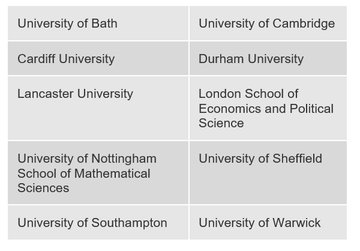
The following universities accept these tests:
| University of Bath | University of Cambridge |
| Cardiff University | Durham University |
| Lancaster University | London School of Economics and Political Science |
| University of Nottingham School of Mathematical Sciences | University of Sheffield |
| University of Southampton | University of Warwick |
However there are talks that the test maybe discontinued from 2024.
TSA - Thinking Skills Assessment – University of Oxford
Most students who apply to University of Oxford have great profiles both academically and extra curricular wise.
This test enables the admission officer to get one more piece of information regarding a students profile.
The Thinking Skills Assessment (TSA) is divided into two parts: a 90-minute, multiple-choice Thinking Skills Assessment and a 30-minute writing task. The TSA will be a paper-based test in 2023.
If you are applying for one of the following courses you will be required to take both sections of the TSA:
- Experimental Psychology
- Human Sciences
- Philosophy, Politics and Economics
- Psychology, Philosophy and Linguistics
However, if you are applying for Economics and Management or History and Economics, you will be required to take only Section 1.
Section 1 is made up of 50 multiple-choice questions and aims to assess the following: Problem-solving skills, including numerical reasoning. Critical thinking skills, including understanding argument and reasoning using everyday language.
Section 2 is a writing task, that seeks to evaluate a candidate's ability to organise ideas in a clear and concise manner, and communicate them effectively in writing. Questions are not subject-specific and candidates must answer one question from a choice of four.
The LNAT
It is used by universities to help them select people for their undergraduate law courses.
The test doesn't test your knowledge of law or any other subject. Instead, it helps universities assess your aptitude for the skills required to study law.
It is a two-part test: multiple choice questions based on passages of text, and an essay.
Section A: The first part is a computer-based multiple choice exam. You'll be asked to read passages of text and answer questions that test your comprehension of them. Your scores from the multiple choice section of the test are checked by computer, and a mark out of 42 is created This is known as your LNAT score.
Section B: In the second part of the test you will be asked to write one essay from a list of three proposed subjects. This section is not marked by the test centre and does not contribute to your LNAT score, but it is your opportunity to show your ability to construct a compelling argument and reach a conclusion.