AMC Demystified
Enhancing Admissions Chances Through Math
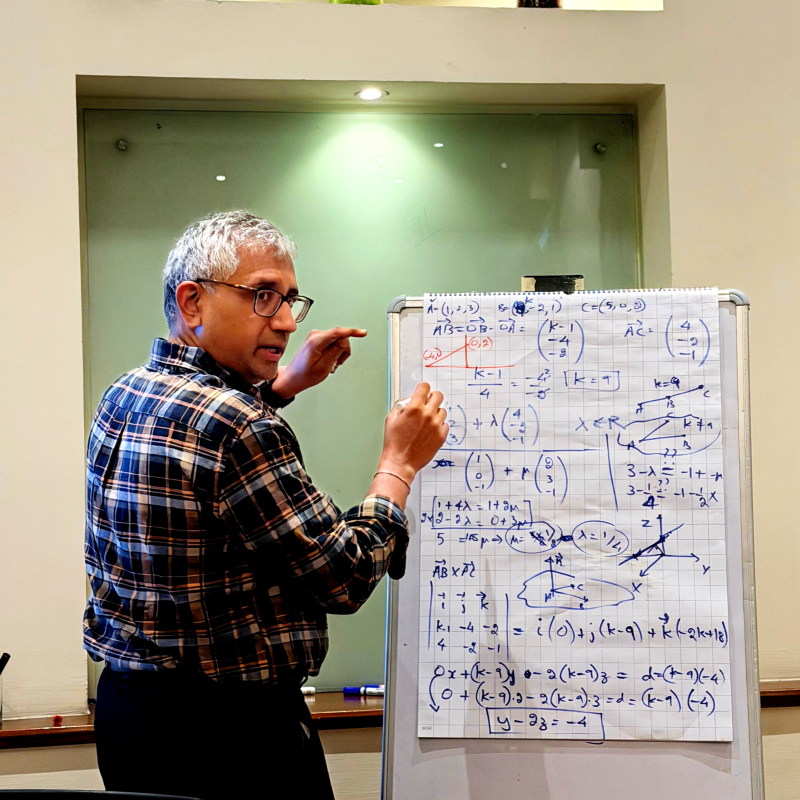
AMC or the American Mathematics Competition is a collection of exams designed to challenge and inspire talented high school students in mathematics. While it forms the baseline exam to ultimately help shortlist a handful of students to represent the United States team in the prestigious International Math Olympiad (IMO), there is a lot of incentive for non-US students as well to give their best shot at it. The popularity of these exams has grown so much over the years that they are taken by students all over the world. The syllabus/scope is both comprehensive and modern. These exams are so well designed that many top universities such as MIT now ask students for their AMC scores as a fundamental ingredient in their applications. It is offered at 3 progressively harder levels - AMC 8, AMC 10 and AMC 12.
Benefits of performing well in the AMCs
- For students outside the US, it can significantly boost their college application profile and thereby admission trajectories into top universities, especially engineering programs. It demonstrates a high level of aptitude and interest in mathematics which can be particularly relevant for those planning to major in a STEM field. This ability and passion for Math stands out to admissions officers.
- Even if a student is not inclined towards STEM, a good performance demonstrates problem solving skills and the ability to think critically; both traits being highly valued by colleges and universities. These skills are important not just in Math and Science but also in other academic areas and at the workplace too.
- Many colleges and universities offer scholarships and other forms of financial aid to students who excel in the AMC exams.
How to Prepare for the AMCs
Preparation requires a combination of practice, strategy and knowledge. Here are some tips:
- Understand the format: These exams are MCQ based which focus on problem-solving and critical thinking in mathematics. The 25 questions get progressively harder, but each question carries the same weightage. It is very important to make sure that no silly mistakes are committed in the easier questions.
- Build your Math skills: The exams cover a range of topics - algebra, geometry, number theory, combinatorics and probability. AMC12 syllabus includes Trigonometry, Complex Numbers and Logarithms as well. Practicing extensively in these topics helps increase both speed and accuracy.
- Practice from previous years exam papers: The past papers are all available online and practicing from them can help one get a sense of the types of questions posed and their associated difficulty level. It can also help identify areas where one needs to focus more.
- Learn test-taking strategies: Knowing how to approach MCQs and managing time effectively is as important as knowing the material. Strategies for eliminating obvious wrong answers, guessing intelligently and optimally pacing oneself can all be big differentiators.
- Join a Math club or study group: This can help one stay motivated and get support from others pursuing the same goals. Learning from each other's approaches is immensely valuable.
- Work with a tutor or teacher: Seek support/guidance from good tutors to ascertain where you need more practice and which topics are easy wins.
Remember, the key to success on the AMC exams is consistent practice and a willingness to learn and improve. With dedication and effort, you can sharpen your math skills and perform well on the exams.
How can a qualified instructor help
There are 3 components to success in competitive Math.
- innate talent - some are naturally gifted.
- mastery by hard work – the more one practices and has exposure to variety of problems, both speed and accuracy improve.
- guidance - an able coach can make a difference by:
- identifying both strong and weak spots for each student. The cut offs typically are about 65% of the max score. Cashing on one's forte is key.
- helping figure which questions to skip. Although the questions are mostly in increasing order of difficulty, some take too long to work out. Having a sense for it helps optimize available time.
- helping learn to eliminate obvious wrong choices by techniques like dimensionality check, symmetry argument, estimation, and limiting case behaviour. AMC8 does not have negative marking, while AMC10, AMC12 do. Nevertheless, this skill drastically increases the probability of getting a question right.
Steps to taking the AMCs
- Find a local test center: The AMC exams are administered by the Mathematical Association of America (MAA) in the United States, but they are also available at select international test centers including India. Check the MAA website to find a test center near you.
- Register for the exam and pay the fees: Once you've identified a test center, you'll need to register. The registration process and deadlines may vary by test center, so be sure to check with the center directly for instructions. A registration fee (around Rs. 1000-1500) is typically paid directly to the test center or through an online payment system.
- Take the exam: On the day of the exam, be sure to arrive early and bring the required materials. Follow the test center's instructions and be sure to manage your time effectively during the exam. Nowadays AMCs are mostly given from home through AI proctoring.
- Receive your results: This takes about 8 weeks. If you perform well, you may be eligible for awards or recognition from the MAA like honour roll or a distinction and may qualify to the next level called AIME.
What next after AMC? What is AIME
The AIME (American Invitational Mathematics Examination) is an intermediate examination between the AMC10 or AMC12 and the USAMO (the nationals). A score of 100+/150 or being in top 5% in AMC12 qualifies one to take AIME. Likewise, 120+/150 or top 2.5% of AMC10.
AIME is a 15 question, 3-hour exam where each answer is an integer from 0 to 999. The questions are much more difficult and unlikely to be solved by guessing. All problems can be solved by pre-calculus methods, although no penalty is imposed for using calculus. Also, no calculators are allowed, like in the AMCs.